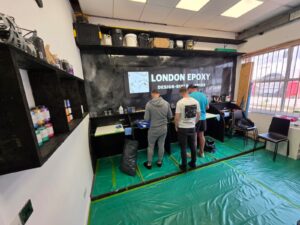
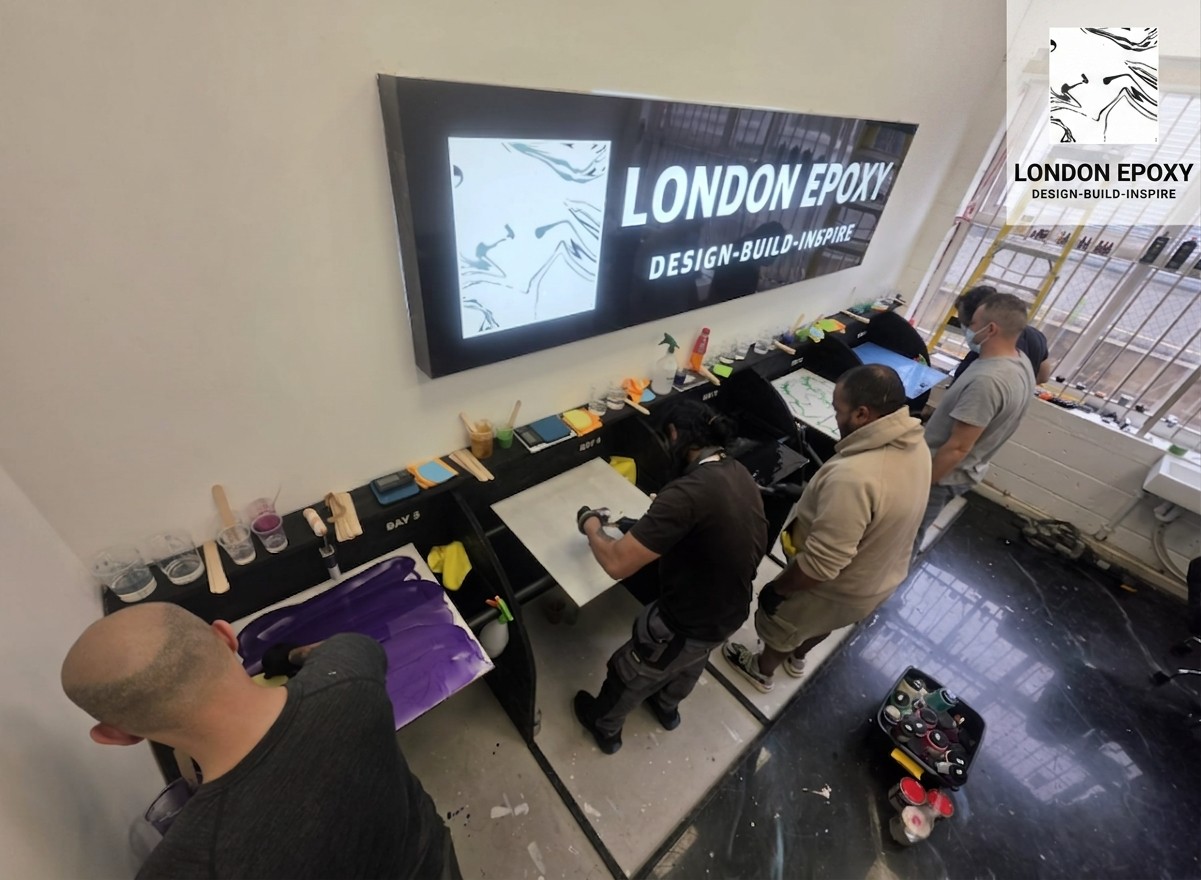
An epoxy resin course in London covers the full installation process — surface preparation, diamond grinding, priming, mixing ratios, base coat application, decorative finishes including metallic epoxy and flake systems, topcoat and safe chemical handling. Most structured courses run over two days on a real training floor. No prior experience is required. Students leave with hands-on technique, a certificate of completion and enough product and supplier knowledge to begin taking on domestic work.
Before You Read On
Key Takeaways
- An epoxy resin course covers the complete installation chain on a real floor — substrate through to sealed topcoat.
- Surface preparation gets the most training time because it is directly responsible for whether a finished floor bonds, lasts and looks right.
- The certificate is a certificate of completion — not an Ofqual-regulated qualification. No government licence is required to install epoxy flooring in the UK.
- The process is learnable on a course. Substrate judgement — reading contaminated slabs, moisture issues, variable real-world conditions — builds over your first year of actual installs.
- London has consistent domestic and small commercial demand for resin flooring — garages, garden rooms, retail fit-outs — making it a workable market from early on.
Course Content
What Does an Epoxy Resin Flooring Course Actually Cover?
A proper epoxy resin course covers the installation process as a chain — because each stage determines what the next stage can achieve. Poor preparation means primer cannot bond. Incorrect mixing means the coating will not cure. Here is what each stage involves and why it matters on real jobs.
Surface preparation is where most coating failures begin and where good training spends the most time. Diamond grinding removes laitance and opens the surface profile so primer has a physical key to bond to. A floor that looks clean is not the same as a floor that is prepared — oil contamination, adhesive residue and old coating remnants all prevent adhesion and none of them are obvious at a glance. After grinding, dust extraction removes the concrete dust that would otherwise block primer penetration.
What students find hardest here: assessing when preparation is genuinely complete versus visually acceptable. That judgement only develops through supervised practice on a real floor.

Substrate moisture. Every epoxy product has a maximum acceptable moisture threshold. Exceed it and the coating will blister or delaminate regardless of how well everything else is done. Training covers how to take readings and what to do when they are borderline.
Mixing ratios are a chemical specification, not a guideline. The wrong ratio produces a coating that cures soft, stays tacky or does not cure at all. Pot life — the working time after mixing begins — shortens significantly in warm conditions. On a London site in summer, a product with a 30-minute pot life at 20°C may give 15 to 18 usable minutes. Understanding this in practice, not just on a data sheet, is what stops installers running out of working time mid-floor.
Pot life example is editorial — verify against the specific product TDS used on your course before citing a precise figure to clients.
Priming creates the bond between prepared concrete and base coat. Product choice matters — damp-tolerant primers handle substrates with elevated but in-spec moisture readings; standard primers are for dry, clean concrete. Using the wrong primer is one of the most consistent early-career mistakes, and it announces itself weeks later when the floor starts lifting.
Base coat and decorative finishes. Squeegee controls coat thickness; spike roller immediately follows to release trapped air and prevent pinholes. Decorative systems are where the work becomes visually interesting:
- Broadcast flake — flakes scattered by hand into the wet base coat. Consistent coverage is the skill; patchy broadcast is obvious on the finished floor.
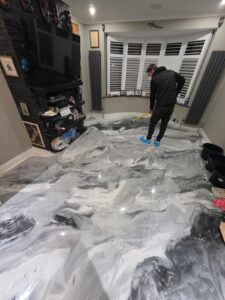
- Metallic epoxy — the depth, movement and reflective finish are created by how the product is worked after application, not just by what product is used. Same tin, two installers, very different results.

Topcoat and safety. The topcoat seals the decorative layer and determines final surface quality. Slip-resistance aggregate is added where required. Safety runs throughout the course — not as a standalone session — because working with uncured epoxy resin carries a real sensitisation risk. According to HSE guidance on epoxy resin, repeated skin contact can trigger an irreversible allergic response. Nitrile gloves, eye protection and a respirator in enclosed spaces are the baseline. COSHH Regulations 2002 apply to self-employed installers — not just employers.
Is It Right for You
Who Is an Epoxy Resin Course Near London For?
No prior experience is required. But the course serves different people for different reasons — being clear about which group you are in helps set realistic expectations.
| Who attends | What they actually get from it |
|---|---|
| Complete beginner, no trades background | Full process from zero — capable of straightforward domestic installs with care afterwards |
| Builder or decorator adding resin to services | Substrate chemistry and mixing discipline; existing site skills transfer directly |
| Flooring contractor who refers epoxy work | Technical knowledge to bring resin work in-house and quote it properly |
| Career changer targeting London market | Practical skill with local demand — needs deliberate portfolio building in first three months |
| Self-taught installer with mixed results | Supervised correction before bad technique becomes a fixed habit |
Honest Assessment
Is Epoxy Resin Hard to Learn?
The application stages are not the hardest part. What takes time is reading a substrate accurately — identifying what a contaminated or moisture-affected slab needs, making the right product call, knowing when not to proceed. On a course you do this on a controlled training floor. On real jobs you encounter a garage with two decades of oil in it or a warehouse floor with a previous coating that was never fully removed. The process is teachable and most people grasp it within the training period. Substrate judgement across variable real-world conditions builds over the first year of installs — conflating the two leads to mispriced jobs and avoidable callbacks.
Qualification & Credentials
What Certificate Do You Get?
You receive a certificate of completion from the training provider. It is not an Ofqual-regulated qualification — no statutory licence is required to install epoxy flooring in the UK, and no government-regulated qualification specific to this trade currently exists.
In practice, domestic clients and small commercial clients treat a certificate of completion alongside a portfolio of completed photographed work as sufficient evidence of formal training. For larger construction site access, a CSCS card may be required separately — that is a site health and safety credential, entirely independent of epoxy training.
Never present the certificate as a regulated qualification to clients. The distinction matters to anyone who knows the difference, and being straight about it builds more trust than overstating it.
Kit After Training
What Tools Do You Need After the Course?
Training covers what gets used during the course and explains what to buy before taking on paid work.
Supplier knowledge is part of the training — where to source product in the UK and how to read a TDS before buying.
The 2-day Epoxy Mastery course runs every second weekend of the month. Certificate of completion included. Places are limited per cohort.
View Dates & Book →Is an Epoxy Resin Course Worth the Money?
The comparison is not course fee versus nothing — it is course fee versus learning the same things through mistakes on real client jobs.
| What training gives you | What self-teaching costs instead |
|---|---|
| Technique corrected on a training floor | Callbacks and rectification on paying clients |
| Tool access during training | Full kit bought upfront before job one |
| Product knowledge from the start | Trial and error across multiple product lines |
| Certificate of completion | No evidence of training when clients ask |
The realistic cost of self-teaching — wasted product, technique errors on client jobs, local reputational damage — is rarely as cheap as it looks when weighing up a course fee.
After the Course
Can You Start a Business After an Epoxy Course in London?
Yes, and London is a practical starting market. Consistent demand for garage floors, garden rooms and small commercial fit-outs means work is available for installers who can show quality. The course gives you the technical foundation — the business side needs separate attention.
Before taking on any paid work:
Public liability insurance first
Before the first job, not after. Working on a client’s property without cover is not recoverable if something goes wrong.
Buy your tool kit before quoting
Not after winning a job.
Document every install
Before-and-after photography at every stage. Commercial clients ask to see completed work. A certificate does not substitute for a portfolio.
Price from actual costs
Material per m², preparation time, overhead, margin. Pricing on instinct consistently undervalues the jobs that look straightforward.
Google Business Profile with real project photos
Free, persistent, highest-return local marketing available to a new installer.
For the full picture on what the first year of installs actually looks like, read the guide to becoming an epoxy flooring installer.
Frequently Asked Questions