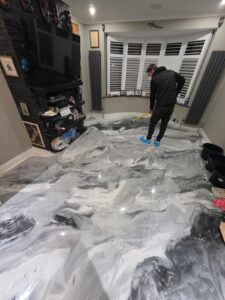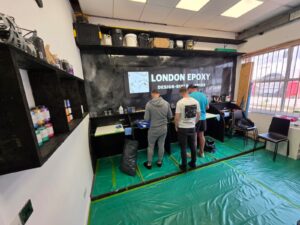

Quick Answer: Becoming an epoxy flooring installer in the UK requires hands-on training — not a government licence. The core process covers surface preparation, diamond grinding, priming, mixing ratios, application, and finishing. Most people complete a structured 2-day epoxy flooring course and begin taking on domestic and small commercial jobs shortly after. Consistent results come from experience across real floor conditions — varying substrates, moisture levels, and job types build the judgement that no course can fully replace.
Before You Start
Key Takeaways
- No regulated UK qualification is legally required — but a certificate of completion from a reputable hands-on course is what commercial clients and builders expect to see.
- Surface preparation causes most early failures. Laitance, contamination and unchecked moisture vapour transmission account for the majority of delaminations and peel-backs on failed installs.
- Two days teaches the process. The first year teaches the trade. Conflating them leads to mispriced jobs and callbacks.
- Earnings are real but not automatic. Material costs, overhead and customer acquisition eat into margins. Pricing discipline matters from day one.
- CSCS cards may be required for commercial site access — separate from epoxy training, and worth investigating early if commercial contracts are in your plan.
Regulation & Licensing
Do You Need a Qualification to Install Epoxy Flooring in the UK?
There is no Ofqual-regulated qualification, government licence or mandatory certification required to legally install epoxy flooring in the UK. Unlike gas engineering or notifiable electrical work, resin flooring sits outside statutory licensing — any competent person can offer these services commercially. That low regulatory barrier is both an opportunity and a problem: it means you can start quickly, but the market includes undertrained installers whose failed floors give the trade a bad name.
A certificate of completion from a recognised hands-on course is the credibility signal that separates you from the unqualified end of the market when speaking to a building contractor or commercial client for the first time. For site access on commercial projects, a CSCS card is frequently required — entirely separate from epoxy training. Check the CSCS card requirements before you start quoting commercial work.
Two pieces of regulation every installer must understand from day one: the HSE COSHH Regulations 2002 govern handling epoxy resin and hardener as hazardous substances, and the HSE skin at work guidance documents the sensitisation risk and your self-employed obligations. Read both before you handle product — not after your first reaction.
Training Timeline
How Long Does It Take to Learn Epoxy Flooring Installation?
A structured two-day course covers the full installation sequence and is enough to take on straightforward domestic work shortly after. But the question people are actually asking is usually a different one: how long until I’m genuinely competent across varied real-world conditions? That answer is closer to six to twelve months of active installs. A training floor is controlled. Client floors are not — contaminated concrete, elevated moisture, poorly laid domestic bases, warehouse floors with decades of oil ingress. The 2-Day Epoxy Mastery course covers the full sequence in that order, for exactly this reason.
“The installers who shorten the learning curve are the ones who document every job — photographs at every stage, notes on substrate condition and product behaviour — and who call the supplier when they encounter something unfamiliar rather than guessing.”
| Stage | Timeframe | What You’re Building |
|---|---|---|
| Hands-on training course | 2 days | Core process, correct technique under supervision, understanding why each stage exists |
| First 3–5 completed jobs | 1–3 months | Real substrate variability, job costing, pot life under pressure, client communication |
| 6–12 months of varied installs | Ongoing | Substrate diagnosis, product selection, pricing confidence, first referrals |
| Specialist systems (metallic, high-build) | Add-on training | Advanced decorative finishes, larger commercial specification work |
Course Content
What Does Hands-On Epoxy Flooring Training Actually Cover?
Good training covers the full installation chain in sequence, because epoxy is a process where each stage enables the next and a preparation mistake doesn’t reveal itself until the topcoat is lifting three months later.
Surface Preparation
Diamond grinding cuts through laitance — the weak, dusty surface layer on concrete — and opens the surface profile to give the primer a mechanical bond. Shot blasting is used on larger commercial areas. Acid etching is sometimes still encountered but has significant COSHH limitations; most professional installers moved away from it as a primary preparation method.
Moisture Assessment
Applying epoxy over a substrate with excessive moisture vapour transmission causes blistering, delamination and adhesion failure. A surface moisture meter is a quick site check; a calcium chloride test or relative humidity probe gives more precise data for borderline cases. The product’s Technical Data Sheet specifies the acceptable threshold — exceeding it means the product will likely fail regardless of how well it’s applied.

Priming, Mixing & Application
The primer creates the chemical bridge for the base coat — primer selection is not interchangeable. Epoxy is a two-component system: resin and hardener combined at the manufacturer’s specified ratio. This is a chemical requirement, not a guideline. An incorrect ratio produces a coating that cures tacky, stays soft or doesn’t cure at all. Pot life shortens in warm conditions: in a London garage in July, a product with a 30-minute pot life might give you 18 usable minutes.
Equipment
What Tools Does an Epoxy Flooring Installer Need to Start?
You don’t need a full van of specialist equipment on day one, but tools that directly affect finish quality are not places to cut costs. Core kit: diamond cup grinder or walk-behind floor grinder, HEPA-rated vacuum for concrete dust (silica inhalation is a documented HSE risk), digital moisture meter, low-speed high-torque drill with paddle mixer, calibrated scales, notched squeegee at the correct gauge, and a spike roller.
On PPE: full nitrile gloves — not latex, which is permeable to epoxy hardener — safety glasses, a respirator for enclosed spaces, and spiked overshoes for wet coats. Skin sensitisation to uncured epoxy resin, once developed, can make working with epoxy products permanently impossible. This is an irreversible occupational risk documented by the HSE. PPE is non-negotiable.
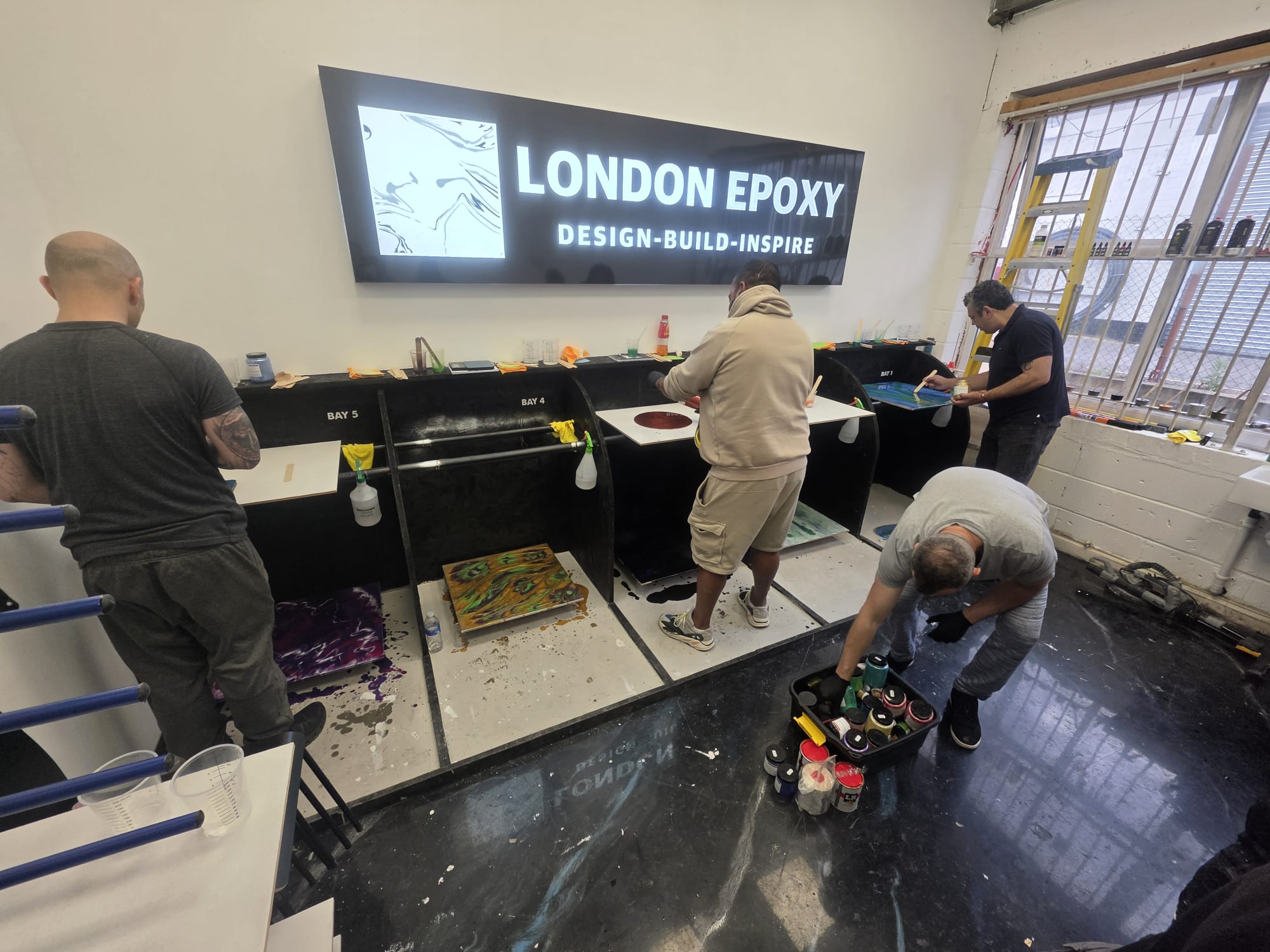
The 2-day Epoxy Mastery course runs every second weekend of the month in London. Supervised installs on a real training floor. Certificate of completion included.
View Course Dates & Book →How Much Does an Epoxy Flooring Installer Earn in the UK?
Per-square-metre rates without cost context are meaningless. What stays in your pocket after materials, labour, overheads and customer acquisition varies significantly based on how you run the business. Material cost per m² varies by system — a solid-colour floor costs less in materials than a decorative flake or metallic finish. Preparation time is the most consistently underestimated cost: on a contaminated slab, prep takes far longer than application.
Overhead new installers routinely ignore: public liability insurance, van running costs, diamond segment consumables, product waste on mixed batches, quotes that don’t convert, and tax — all of which come up repeatedly in the questions we get asked before and after the course.
Getting Started
Step-by-Step: From Course to Operating Installer
Complete hands-on training
A course covering the full installation sequence on a real floor — not a theory day. Read the HSE COSHH and skin sensitisation guidance before you handle product for the first time.
Get insured before your first paid job
Public liability insurance is non-negotiable. Working on a client’s property with chemical products and heavy preparation equipment without it leaves you fully exposed.
Build your reference portfolio before you need it
Your first two or three jobs exist to produce before-and-after evidence. Commercial clients will ask to see previous floors before they commit — the same way you’d look at what past students have produced before deciding whether a course is worth your time.
Set up your Google Business Profile with real photos
For local epoxy flooring work, a well-maintained profile with genuine before-and-after photography is the highest-return marketing activity for a new installer. It costs nothing and runs continuously.
Price correctly from day one
Work out your material cost per m² for each system. Add realistic preparation time, a share of overhead, and margin. Many competitor quotes are not profitable — don’t use them as your benchmark.
Choose your starting market deliberately
Domestic work — garages, workshops, garden rooms — is the right entry point for most new installers. Smaller jobs, more forgiving clients, faster portfolio build. Small commercial units come next.
Frequently Asked Questions